I am currently delving into a deeper understanding of the true meaning of the cross of Christ, how it relates to salvation and how it reveals God's heart.

Friday, February 22, 2008

Assembling Sanctification

See to it that no one comes short of the grace of God; that no root of bitterness springing up causes trouble, and by it many be defiled. (Hebrews 12:15)

Causes trouble, or trouble you. The original means to crowd in, annoy.

Defiled. To sully, taint, contaminate.

This verse is describing what appears to be the opposite of sanctification from the previous verse. It is distraction as opposed to becoming single-minded and devoted. It is being annoyed much of the time instead of being at peace. It is being defiled instead of being purified. It is being sullied instead of shined. It is contamination instead of cleansing. It is being tainted by sin instead of producing the peaceful fruit of righteousness.

Let me look back over the passages I have been studying for the last several weeks to see what is involved in this thing called sanctification. What do I find here in the context that may explain what would be seen in a life being sanctified?

In chapter eleven there are many descriptions of people who were being sanctified. Many of their experiences were very exciting and many were things that most of us would not want to happen to us. But the chapter ends up on a note relating that God intends there to be many people somehow bonded together in this process. Chapter twelve talks about this great cloud of witnesses surrounding us. That certainly implies a group mentality, not an individualistic concept of religion.

Then I see a number of phrases that are likely to be seen in one being sanctified.

Lay aside every encumbrance and the sin which so easily entangles us.

Running the race set before us with endurance.

Fixing our eyes on Jesus, the author and finisher of our faith.

Considering Him who has endured so that we will not grow weary and lose heart.

Resisting and striving against sin.

Remembering the exhortation which is addressed to us as sons about discipline.

Becoming subject to the Father of spirits and receiving life.

Accepting discipline for our good and sharing in His holiness.

Having the peaceful fruit of righteousness become evident in our lives.

Strengthening or lifting our hands and our knees that are feeble.

Making our paths straiter and more level and being healed.

Pursuing peace with all men.

Pursuing sanctification so that we will see God.

Going all the way to accept the grace of God in order to eliminate all roots of bitterness.

These are the things that I have seen so far in this chapter. I was led to this passage several weeks ago to be taught and mentored by my heavenly Father about dealing with my own roots of bitterness. He has been teaching me every day, not only in my exposure to His word here but during the day in my experiences and impressions from His Spirit in various circumstances. I know there is still much more to come, but so far it has been a very rewarding experience for me.

(next in series)

Wednesday, February 20, 2008

Poison of Bitterness

See to it that no one comes short of the grace of God; that no root of bitterness springing up causes trouble, and by it many be defiled. (Hebrews 12:15)

See to it – is this for ourselves or for us to help others around us?

Comes short of the grace – the original meaning of grace is being set up with everything one needs for an abundant and successful life. Coming short of grace then would be failing to receive and utilize that provision. Coming short is also the definition from the Greek word for sin.

Root... springing up – the opposite of pursuing peace and sanctification or a result of trying for those things but stopping short.

Causes trouble – bitterness always causes trouble, not only for the bitter person but for those who become infected around them. It has to do with our sphere of influence. I looked up the word defiled. The Greek word means to crowd in or annoy. That reminds me of the parable of the sower and the weeds that crowd the good plants and starve them out.

See to it – literally to beware, take the oversight. This is implied here as another instruction parallel to not coming short of grace.

Roots of bitterness are the enemy of peace with men and with God. Roots of bitterness if not dealt with will undo everything God is trying to accomplish in our life both with others and with Him. Roots of bitterness not only create trouble and poison but they grow and they spring up. This implies that the roots are lying latent in the ground of our hearts unnoticed but still connected to the soil and alive. Given opportunity they spring to life and produce visible shoots that can quickly grow into very troublesome weeds or poisonous plants. I wonder if bitter roots are what grows poison ivy? Is my bitterness like beautiful green poison ivy leaves that create trouble in the lives of anyone who touches me? I hate poison ivy and similar such plants, I have all of my life. But I never dreamed that maybe my effect on people around me was similar to the effect of poison ivy on me whenever I happen to brush against it. God deliver me from bitter roots today.

One of the things that is so despicable about getting a case of poison ivy, at least for certain people, is the ugliness that it produces on someone's beautiful skin. Of course that is not the reason I dislike it so much for myself, but for someone who has enough beauty to draw attention naturally to themselves it can be a very humiliating experience. Likewise, the poison of bitterness can deface and mar the beauty, not only in our own life but in how we perceive others and even God. Poison is the enemy of beauty and glory.

(next in series)

Tuesday, February 19, 2008

Pursuing Peace with All

Pursue peace with all men, and the sanctification without which no one will see the Lord.

(Hebrews 12:14)

Sanctification is the process of clearing roots, leveling and straightening the path (v. 13) and enduring the strain of being discipled by God (v. 5-11). Grace (v. 15) is the provision of all the equipment and strength and resources that we need for this process. But we must make the choices to lay hold of the provisions and exert the muscles of our minds and emotions to tackle the problems. We do this by lifting up our hands in worship and praise to receive the blessings of God and by lifting up our knees to walk forward (v. 12). In doing so we find that we are receiving therapy to strengthen and heal our weak knees (v. 13) and have more and more endurance for discipline (v. 7).

No one will see the Lord. See in the original means, “to gaze upon with wide-open eyes as at something remarkable, not with merely mechanical, passive or casual vision.”

The original word for peace has within it the concept of atonement. We are not only to be atoned to God but are to pursue atonement with all men as much as possible. Peace with all men is the counterpart to peace with God which is sanctification. We need grace from God to do both of these things. It takes a lot of grace to pursue peace with all men. While we surely will not achieve peace with all men, we are to pursue it. But we can certainly pursue peace with God and will never fail to achieve it if we are willing to pursue it and not stop short of the grace provided for us.

What I am seeing in these verses is bitterness verses beauty. It is only in being sanctified that I am able to begin to see the real beauty of God. But sanctification is the process of removing bitterness from my heart and mind. Sanctification is a prerequisite for seeing the beauty of God more fully.

I also see this passage as strikingly parallel to the one in Isaiah that I keep thinking about along with this one in Hebrews. Take a look at the similarities yourself.

"Let every valley be lifted up, And every mountain and hill be made low; And let the rough ground become a plain, And the rugged terrain a broad valley; Then the glory of the LORD will be revealed, And all flesh will see it together; For the mouth of the LORD has spoken." (Isaiah 40:4-5)

(next in series)

Monday, February 18, 2008

Leveling and Straightening Paths

Make straight paths for your feet, so that the limb which is lame may not be put out of joint, but rather be healed. (Hebrews 12:13)

A voice is calling, "Clear the way for the Lord in the wilderness; make smooth in the desert a highway for our God. "Let every valley be lifted up, and every mountain and hill be made low; and let the rough ground become a plain, and the rugged terrain a broad valley; then the glory of the Lord will be revealed, and all flesh will see it together; for the mouth of the Lord has spoken." (Isaiah 40:3-5)

I visited this verse back on February 12th but as is often the case I keep listening and hearing more that I want to absorb. Just what does this leveling and straightening of the path mean in actual life? What is it in my life or thinking that must happen to level the path? What is a cause for stumbling for both me and others that needs to be leveled or straightened?

Maybe it is the discipline process discussed previously in this chapter that constitutes the leveling process that we naturally tend to resent and resist. If I am instructed to pursue peace with all men and I have obstacles to that peace, then those are high spots or mountains that need to be lowered, excavated, even blown apart if necessary. If I am to pursue sanctification without which I cannot see God then there are ruts and valleys that terrify me that need to be filled in to bring them up into the light and out of fear. The ruts of old habits, ways of thinking and relating, assumptions and paradigms that need to be released and exchanged with God's perspective, these all hold me locked in their control over my life.

Grace (v. 15) is the extravagant supplies for my complete success that have been provided for me by Jesus. But if I fail to receive this grace to empower me to endure the discipline needed to level and straighten the paths in my mind and heart and relationships, then I fall short of that grace and will not be able to cooperate with God's work in my life. When that is the case I will have seeds that produce roots of weeds that will quickly spring up crowding out the slower growing plants of real goodness in my life planted by the Holy Spirit. Weeds typically grow faster and crowd out the good plants robbing them of needed nutrition, water and sunlight.

Trying to walk on a path full of weeds, briars and/or covered with tree roots is a very difficult task at best. It tends toward heightening the danger of putting weak knees and ankles out of joint or causing a sprain. That is quite clear in the analogy, but I still want to know how it applies to my own emotions and heart condition? I need to explore much more clearly what this all means in real life for me.

One thing that comes to mind is the pride scale. The pride scale creates unevenness that must be dealt with. This whole scale is the flesh's attempt to create value and identity apart from God. Anything I imagine beyond reality (reality is God's definition of my identity) that I believe about myself must be removed and anything below that reality must be filled in. Twisted ideas about myself, about God, about others are crooked ways that need to be straightened. Perversions of truth, either factual or emotional make up the crookedness and unevenness that needs to be corrected to make it easier to move forward.

The whole object of a path is to provide access and direction for movement from one place to another. Those who insist on “standing firm” and refusing to move beyond their present concept of truth are often refusing to lift up their hands toward God and their knees to move forward. Discipline sometimes involves the work required to hack a path through the woods and underbrush and weeds so that it becomes more clear to others who are following us.

"I will lead the blind by a way they do not know, In paths they do not know I will guide them. I will make darkness into light before them And rugged places into plains. These are the things I will do, And I will not leave them undone." (Isaiah 42:16)

The Spirit of the Lord GOD is upon me, Because the LORD has anointed me To bring good news to the afflicted; He has sent me to bind up the brokenhearted, To proclaim liberty to captives And freedom to prisoners; To proclaim the favorable year of the LORD And the day of vengeance of our God; To comfort all who mourn, To grant those who mourn in Zion, Giving them a garland instead of ashes, The oil of gladness instead of mourning, The mantle of praise instead of a spirit of fainting. So they will be called oaks of righteousness, The planting of the LORD, that He may be glorified. (Isaiah 61:1-3)

Put out of joint... Other translations have a completely different interpretation of this Greek word. I believe there is a lot to be learned from both of the possible meanings. This is the other way that translators render this phrase. And make straight paths for your feet, that that which is lame be not turned out of the way, but rather be healed. (Hebrews 12:13 ASV)

What struck me when I looked up this word was the similarity between the meaning of this word and the meaning of repentance. It almost appears to me that this may be the opposite of repentance in some way. Both terms mean to turn around, to change direction. In the case of repentance it means to have a change of mind, of thinking, of perception. Repentance is a gift from God that we receive and exercise by our will. In this verse the turning seems to be almost a re-turning back to the direction which repentance had turned us away from.

The cause for the turning brought about in repentance is the heart's response to the attraction of God toward Himself and His heart. Seeing something of the beauty of God, the loveliness of His character, His faithfulness and trustworthiness causes us to want to quit running away from Him and turn toward Him by accepting His invitation into a life-giving relationship with Him.

What I see in the Word here in Hebrews is almost the opposite in some respects. It seems to describe some who are trying to move toward God but become discouraged because of the roughness or twistedness of the apparent path leading toward heaven and God. It describes the lack of needed healing apparently because of continuing damage from paths that are very difficult to travel – too difficult as far as God is concerned because He is asking us to do something about it.

In this passage we are asked to make corrections to the path so that the lame, whether others or even ourselves, are not induced to give up moving in the right direction and turn back toward where we have come from. What is also implied here is that healing is found in moving forward on this path and conversely healing will not be experienced if the lame turns back in discouragement. It also implies that there is a certain amount of responsibility on our part for the condition of the path.

This highlights the need to address the many unnecessary obstacles that we have placed in the way toward God in many respects. Our traditions have created a great deal of distortions that prevent or discourage people from moving toward God. The proliferation of lie-based beliefs about God so popular in all religions are a major cause for the twisted and contorted paths that we try to follow to heaven. Even the condition of the spirit and attitudes of those professing to be followers of God are often a source of discouragement for others who are in need of healing. There are many others sources of problems that need to be addressed in order to smooth and straighten the path to heaven for ourselves and others.

I am now starting to see, given this context, the reason for the next verse. It is the imperative, the focus needed by a person who accepts this job of trailblazing for God. It addresses the issues both in our relationship with others and our relationship with God.

Pursue peace with all men, and the sanctification without which no one will see the Lord. (Hebrews 12:14)

(next in series)

Sunday, February 17, 2008

Bitter Roots in the Landfill

“We don't have problems, we have opportunities”. That was the company line I was given soon after I joined a hand-picked team of designers and engineers at Whirlpool a number of years ago to design a completely, radically different washing machine from scratch. We had been assigned not to just rework or modify any existing design but to think way outside the box and come up with something completely new that would challenge each one of us to the maximum of our creativity. It was one of the most enjoyable jobs I have ever had in my life, primarily because of the freedom to utilize my creativity in teamwork with others who were not afraid of change.

But when we came up with seemingly impossible obstacles in the progress of our design – and that quickly became the norm – we were instructed to view them from the perspective of the old adage quoted at the beginning. We were to change our whole frame of reference, the fundamental way we perceived situations at a deeper level of our mind. This presented some real challenges for me.

My first reaction was one of secret but very intense skepticism. I had not worked there all that long but I was already becoming familiar with the enormous amount of hypocrisy that is so prevalent in the corporate world. It seemed that every few months top management would be taken by the latest craze in the world of motivation and success formulas from expensive corporate consultants and everyone would be required to go through some new intensive mental training program to learn the latest buzzwords and psychological policyspeak until the next consultant guru came along and all of the previous clichés were eclipsed with the latest round of imposed catchphrases.

Needless to say, I quickly caught on that people who had been around for awhile were quite used to all these mind games and had learned to talk the talk simply to keep themselves in favor with those who determined their salary. But they also tended to maintain an inner opinion that was seldom swayed by all the external noise and hoopla. What I found, especially among older engineers was a very deep level of suspicion and doubt about the potential for any real progress which became a problem for me when I wanted to propose radically different approaches to engineering made possible by the rapid advance of computers that they were unfamiliar with.

This problem tended to bring me around full circle to the problem I had myself – very deep-seated skepticism. The first time I heard an engineer declare that we did not have problems, just opportunities inwardly I sneered with contempt. “Yeah, right” I thought, “that's just another cliché we are supposed to spout off. But everyone knows that these are still really problems.” To me this was just another symptom of the pervasive corporate hypocrisy that was becoming apparent to me and in addition it directly crossed my natural skepticism. Insisting that I think and talk about problems as really opportunities not only irritated me a bit but had the potential for creating a spirit of bitterness that I had to keep hidden if I wanted to continue to be a part of this elite team.

So why did this come to my mind this morning? Well, I just read from my morning devotional book about the thousands of hours of painful and intensive training, effort, energy and pain that goes into the execution of just one well-planned successful football maneuver. Much of that training cannot really be considered that much fun while it is being endured, but the ultimate objective when realized brings a great deal of satisfaction and, in this arena, a great deal of glory for a short time. But it is also true that if that training was not willingly endured but was aborted due to the interference of bitterness taking over the mind, the potential champion would not be formed in the mind and body of the athlete and he would be replaced by someone else more willing to endure the hardships of training to achieve the ultimate goal.

It is starting to be even more clear to me the grave dangers of allowing the poison of bitterness to remain in my life. It appears that bitterness may be one of the worst enemies of success, achievement and victory that there is. It suffocates hope, it infects the heart with depression and discouragement, it is debilitating and it weakens friendships. The more I become aware of the symptoms of this poison the more painfully aware I become of the evidence of those symptoms throughout most of my life and my relationships. It is becoming very clear that I desperately need a detox program to rid my system of this pernicious poison. But it has so deeply infected my heart that I cannot do it on my own. I need a really good Doctor as well as skilled medical assistants to help me in my recovery.

What I am learning here in Hebrews 12 is the exposure of more and more roots of bitterness that are grown all through the soil of my life. Trials and discipline have been sources of bitterness for me. Broken promises and neglect, lack of acceptance of love have long been a source of bitterness for me. The unfairness of life and the lies about God that I inherited as well as the ones I developed have been reinforcements of the bitter conclusions that I have often subconsciously drawn about God and His treatment of me. The seeming randomness of evil in this world and the unanswered questions that plague everyone about life are additional fuel for the intensifying of bitterness when they are allowed to fester in my heart. All of these things and more have added together to simmer far beneath the surface in the cesspool of bitterness that has long remained hidden out of sight.

But like any landfill filled with garbage, the unresolved baggage in my heart has not failed to produce the methane gases of bitterness that can seep to the surface at times and produce foul odors and unpleasant relationships. This bad atmosphere has likely kept me at a distance from many that I have longed to connect with at a much deeper level but could never do so, much to my frustration and grief. These events just added to the fuel for the landfill as I tried to bury each succeeding failure and the pain of lost friendships into the growing landfill of my heart that has by now become quite a sizable mountain. What a mess I have. And with roots full of bitterness grown all through this landfill it is no wonder that I have such a difficult time producing decent fruit on the limbs of my external life. The same sap that flows in the roots will eventually feed the fruit as well.

Like Paul I feel very much like crying out, O wretched man that I am! Who will deliver me from this body of death? (Romans 7:24 NKJV) My only hope is to finish the exclamation with the same conclusion that Paul had to make in the very next words.

Thanks be to God –through Jesus Christ our Lord! So then, I myself in my mind am a slave to God's law, but in the sinful nature a slave to the law of sin. Therefore, there is now no condemnation for those who are in Christ Jesus, because through Christ Jesus the law of the Spirit of life set me free from the law of sin and death. (Romans 7:25 - 8:2 NIV)

(next in series)

Saturday, February 16, 2008

Drooping Hands and Weak Knees

Wherefore lift up the hands that hang down, and the palsied knees; and make straight paths for your feet, that that which is lame be not turned out of the way, but rather be healed. Follow after peace with all men, and the sanctification without which no man shall see the Lord: looking carefully lest there be any man that falleth short of the grace of God; lest any root of bitterness springing up trouble you, and thereby the many be defiled. (Hebrews 12:12-15 ASV)

Therefore, strengthen the hands that are weak and the knees that are feeble... (Hebrews 12:12 NAS95)

I was a little baffled by the translation that I study from, the NAS95 quoted last here, until I looked up the original as well as a number of other translations. I believe from looking at all of these that the ASV best describes what the original intent of the text was, especially for verse 12. It also has strong implications of reference to parallel verses in Isaiah that I believe this alludes to. Particularly I think these apply: Isaiah 40:1-11; 42:16 and all of chapter 61.

One of my initial questions is, why does it specifically mention hands and knees?

Lifting hands implies worship and looking to God for strength. If the hands are hanging limp then it may mean that there is discouragement going on and a lack of focusing on Jesus. Most likely if the hands are hanging limp then the head may be hanging down along with them.

What I find when looking at the Greek and even some of the English translations is an implication of lifting up the knees as well as the hangd implying walking, setting out, beginning to move. Putting these two ideas together creates a picture of a person who is simply standing around feeling tired, who has lost heart (v. 3) or grown faint from the unexplainable trials that seem to be plaguing them for no good reason (v. 5-11) The do not realize that their condition of being static in their growth and experience is because they have forgotten the exhortation addressed to them as sons about these experiences (v. 5) and they are not focusing on Jesus (v. 2). Consequently they are standing still on an apparently very rough path that is too difficult and tiring to continue on and are feeling very stuck. (Hey, this is starting to feel all too real and personal.)

Then the text addresses the need for better paths so the weak knees are not twisted by uneven ground. I have many times walked on very rough ground, sometime when hiking on rough terrain and sometimes when working on rough areas planting trees on land that had not been cleared very well. I know the intense frustration of feeling like it took a lot of effort to not make very much progress. I also know that it is not very hard to end up twisting an ankle or even a knee if not being very careful while trying to navigate such terrain. In addition, if I am not in very good physical shape the danger of turning a joint is even greater.

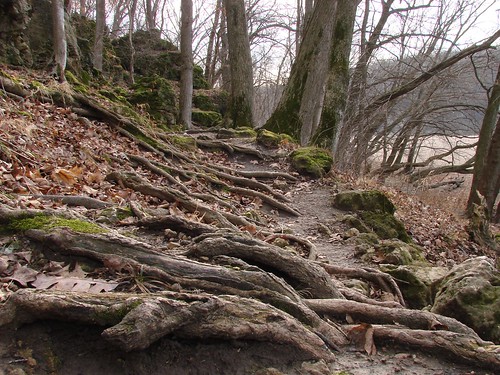
One of the most annoying obstacles and dangers for twisting an ankle or knee is roots that get in the way. They are much worse than fallen sticks because they are anchored into the ground and will not move out of the way when hit with your foot or leg. Consequently they become much more likely to be an occasion for stumbling than most other obstacles. If your foot gets caught underneath one and you can't catch yourself quick enough it can cause serious injury. I can certainly see how roots of bitterness can be a similar cause for problems in my spiritual and social life.

What is it that strengthens and tones up my legs and body so that this danger is lessened? Resistance training (v. 4) that comes from a graduated exercise routine and also learning from experience the coordination necessary to move carefully but swiftly across very rough land or even jumping boulders in canyon creeks.

What I see in this passage is not just an urging to lift up my hands and focus my attention more on God, but also to pick up my weak knees and start moving in some direction so that I will begin making at least some progress away from where I currently am. But in addition to that I also may need to spend some time helping repair the condition of the paths that are so rough for me, paying particular attention to removing the dangerous roots so that others will not be in so much danger of becoming hurt from the confusion and unevenness of the ground. As I help to make the paths straighter and smoother for my own feet I am also helping pave the roads so that others following me may make more efficient progress than what I have experienced. Maybe this hearkens back to 11:39, 40. Both those who go before and those who follow after work together in God's plan so that they all become interconnected with each other to be perfected in the faith of Jesus.

The reason given here for the straightening of the paths is not only to avoid dislocating a knee or twisting an ankle, which could definitely slow down or stop someone's progress, but for healing as well. Healing usually takes time and also therapy many times. It means not overstressing a damaged or weak muscle. My daughter is working in a physical therapy rehab center and tells us many stories of people coming in after operations or accidents and needing muscle and joint rehabilitation and healing. There is a science to this process that she is actually going to school right now to learn. And the same kind of science needs to be applied in our emotional and spiritual healing as well.

So just where is this path leading that needs to be leveled and straightened? What is the direction we are to begin moving while lifting up our limp hands and picking up our knees one after the other? I think maybe the next verse give us some instruction about this.

I see two things in verse 13 as reasons for needing to do all of the above. (1) Pursue peace with all men, and (2) pursue the sanctification without which no one will see the Lord. Evidently these two things are considered the main reasons for even participating in this whole operation, the goals of the path that we are choosing to travel with Jesus. I want to spend much more time exploring these two things later.

But most importantly mentioned here, our ultimate goal is to see God. That was the passionate plea of Moses on Mt. Sinai, he wanted to see God's glory, and it has been the underlying hunger of every heart born into this world whether they ever know it or not. Our heart was designed to be connected with God and will never really know full satisfaction with any substitute. Unfortunately many do settle for cheap counterfeits and think that those are the best that can be had. But God is not going to rest until everyone possible has been drawn into His original plan of intimacy with His own heart and they have become filled to overflowing with the immense joy and pleasures that He designed us for.

Then I will go back to my place until they admit their guilt. And they will seek my face; in their misery they will earnestly seek me. (Hosea 5:15 NIV)

If my people who are called by my name humble themselves, pray, seek my face, and turn from their wicked ways, then I will hear from heaven, and will forgive their sin and heal their land. (2 Chronicles 7:14 NRSV)

"Come," my heart says, "seek his face!" Your face, LORD, do I seek. (Psalms 27:8 NRSV)

(next in series)